- 0086(21)62671680
- 62671061
- sales@hyssgroup.com
- Language
Weld Neck, Slip-On, Socket Weld, Threaded, Lap Joint or Blind Flange: Which to Use
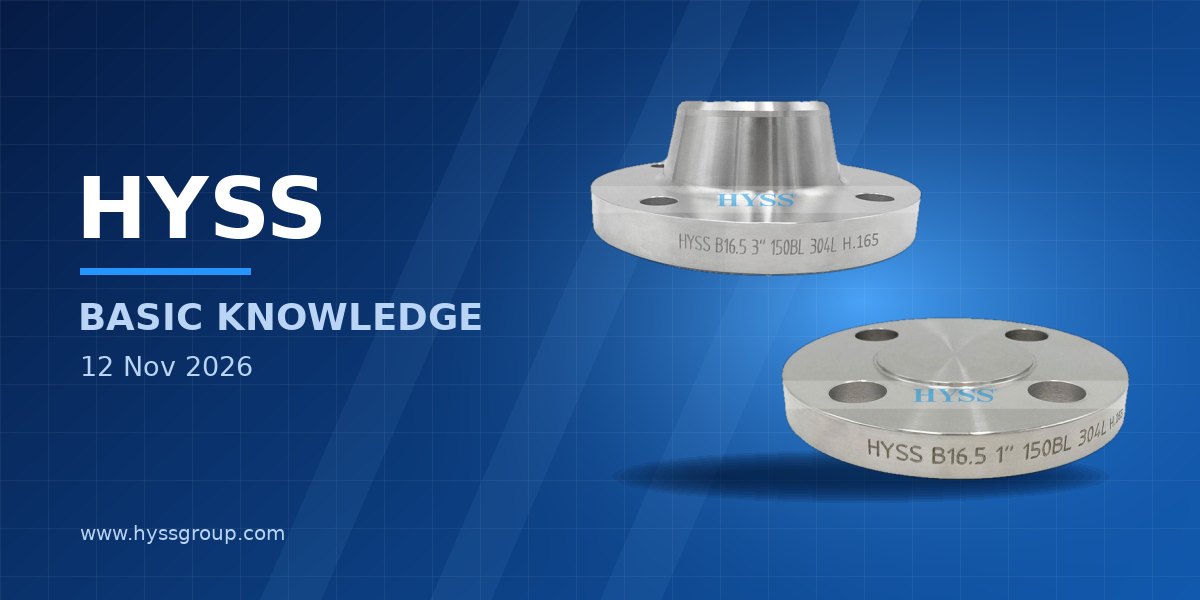
ASME B16.5 and EN 1092-1 offer several ways to attach a flange to a pipe. The choice affects strength, cost, installation time and maintenance. This guide explains what each type is for, so that the flange on the purchase order matches the duty in the line.
A weld neck flange has a long tapered hub that is butt welded to the pipe. The hub spreads stress from the flange ring into the pipe wall, which makes WN the preferred choice for high pressure, high or very low temperature, cyclic loads and hazardous fluids. The butt weld can be fully radiographed. The bore of the hub must match the inside diameter of the pipe, so the pipe schedule or wall thickness has to be stated when ordering.
A slip-on flange slides over the pipe and is fixed with a fillet weld on the inside and outside. It is cheaper, needs less accuracy in cutting the pipe and is easy to align. Its strength under pressure and especially under fatigue is lower than that of a weld neck, so it is used on utility and moderate process lines rather than in severe cyclic service. Many piping specifications limit or forbid slip-on flanges above a certain class or temperature.
A socket weld flange has a counterbore into which the pipe is inserted and then fillet welded on the outside. It is normally used for small bore lines, typically NPS 2 and below. Good practice is to leave a small gap between the pipe end and the bottom of the socket before welding, to allow for weld shrinkage and thermal expansion. The gap left inside the joint can trap fluid, so socket weld flanges are avoided where crevice corrosion is a concern and in hygienic service.
A threaded flange screws onto a threaded pipe, usually with tapered pipe threads to ASME B1.20.1 (NPT). No welding is needed, which is useful in areas where hot work is restricted and for galvanised pipe. Threaded joints are limited to small sizes and lower pressures, and they can leak under vibration or temperature cycling. Some specifications require the thread to be seal welded.
A lap joint flange sits loosely behind a stub end that is butt welded to the pipe. Because the flange can rotate, bolt holes are easy to align, which helps on lines that are taken apart often. Only the stub end is in contact with the fluid, so a carbon steel flange can be used with a stainless steel or nickel alloy stub end to save cost. Lap joint assemblies are not the first choice for high bending loads.
A blind flange has no bore. It closes the end of a pipe, nozzle or valve, provides access for inspection and cleaning, and leaves room for future connections. Because it carries the full pressure load across its face, a blind flange is thicker than other flanges of the same rating.
| Type | Typical use | Main limitation |
|---|---|---|
| Weld neck | High pressure, temperature, cyclic or hazardous service | Higher cost; bore must match pipe |
| Slip-on | Utility and moderate process lines | Lower fatigue strength |
| Socket weld | Small bore lines | Crevice inside the joint |
| Threaded | Small, low-pressure, no hot work | Leak risk under vibration |
| Lap joint | Frequent dismantling, expensive alloys | Not for high bending loads |
| Blind | Closing ends and openings | Heavy at large sizes |
Related products: Forged flanges
THE MEMBERS OF HYSS GROUP
1.Zhejiang Hyss Corp.
2.Zhejiang Hyss Pipeline Industrial Corp.
3.Hyss International Trading (Shanghai) Co., Ltd.
4.Hyss International Limited.
5.Hyss International Logistics(Shanghai)Co.,Ltd.
6.Hebei Hyss Corp.
SALES CENTER OF HYSS GROUP
Add:Room 1507,No.1 Building,GuoSon Center,No.388
Zhongjiang Road,Shanghai,China
Postal Code:200062
Tel: 0086(21)62671680 / 62671061
Fax:0086(21)62671932
 The function is under construction, so stay tuned!
 la fonction est en construction, alors restez branchés!
 La función está en construcción, así que ¡mantente atento!
 A função está EM construção, então fiquem ligados!
 функция находится в стадии строительства, так что оставайтесь на связи!