- 0086(21)62671680
- 62671061
- sales@hyssgroup.com
- Language
Flange Facing Types Explained: RF, FF, RTJ, Tongue and Groove, Male and Female
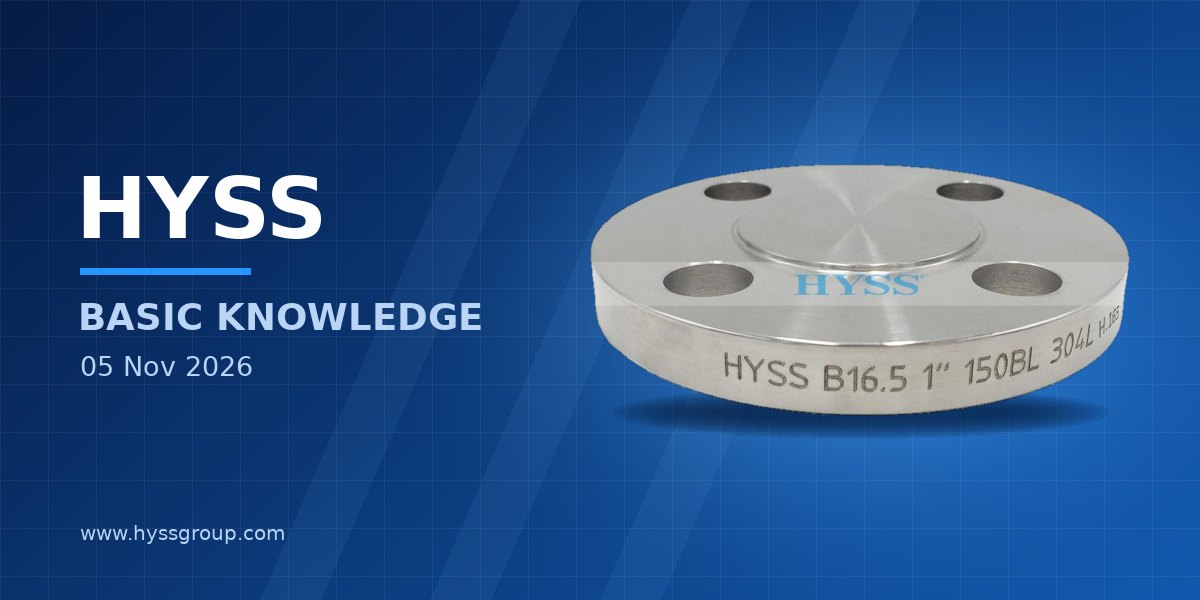
The facing is the part of a flange that seats the gasket. Two flanges can have the same size, pressure rating and bolt pattern and still not seal if the facings do not suit each other or the gasket. This article explains the facing types used in ASME B16.5 and their counterparts in EN 1092-1, and how to specify them correctly.
The raised face is by far the most common facing in process piping. A ring-shaped area around the bore stands above the bolting surface, so the bolt load is concentrated on the gasket. In ASME B16.5 the raised face height is 1/16 in (about 1.6 mm) for Classes 150 and 300 and 1/4 in (about 6.4 mm) for Class 400 and higher. When comparing flange thickness from different catalogues, check whether the raised face is included in the quoted figure.
RF flanges are normally supplied with a serrated (spiral or concentric) finish that grips soft and semi-metallic gaskets. ASME B16.5 gives a roughness range for this finish; spiral wound gaskets to ASME B16.20 and non-metallic gaskets to ASME B16.21 are the usual partners.
A flat face flange has a gasket surface level with the bolting surface. It is used where the mating flange is cast iron, ductile iron, plastic or another material that could crack if bolted against a raised face, and on some low-pressure water and utility lines. FF flanges use a full-face gasket that covers the whole surface up to the outside diameter. Never bolt a steel RF flange to a cast iron FF flange: the raised face acts as a fulcrum and can break the brittle flange.
An RTJ flange has a precisely machined groove that holds a solid metal ring. When the bolts are tightened the ring deforms into the groove and creates a metal-to-metal seal. RTJ facings are common in high-pressure, high-temperature and hydrocarbon service, typically Class 600 and above, and in wellhead equipment. Ring gaskets are octagonal or oval (R type), or the pressure-energised RX and BX types; ring numbers and dimensions are given in ASME B16.20 and, for wellhead equipment, API 6A. The ring should be softer than the groove so that the ring, not the flange, deforms.
These are matched pairs. One flange has a raised tongue or male step; the mating flange has a groove or female recess. The gasket is trapped and cannot blow out, and the pair is self-centring. They are used for some high-pressure, toxic or vacuum services and in heat exchanger and pump connections. Because one flange cannot be replaced by a standard RF flange, both halves must be ordered as a set, and the large and small variants must match.
| EN 1092-1 | Description | Closest ASME term |
|---|---|---|
| Type A | Flat face | FF |
| Type B1 / B2 | Raised face (B2 has a finer finish) | RF |
| Type C / D | Tongue / groove | Tongue and groove |
| Type E / F | Spigot / recess | Male and female |
| Type G / H | O-ring spigot / O-ring groove | – |
Related products: Forged flanges
THE MEMBERS OF HYSS GROUP
1.Zhejiang Hyss Corp.
2.Zhejiang Hyss Pipeline Industrial Corp.
3.Hyss International Trading (Shanghai) Co., Ltd.
4.Hyss International Limited.
5.Hyss International Logistics(Shanghai)Co.,Ltd.
6.Hebei Hyss Corp.
SALES CENTER OF HYSS GROUP
Add:Room 1507,No.1 Building,GuoSon Center,No.388
Zhongjiang Road,Shanghai,China
Postal Code:200062
Tel: 0086(21)62671680 / 62671061
Fax:0086(21)62671932
 The function is under construction, so stay tuned!
 la fonction est en construction, alors restez branchés!
 La función está en construcción, así que ¡mantente atento!
 A função está EM construção, então fiquem ligados!
 функция находится в стадии строительства, так что оставайтесь на связи!