- 0086(21)62671680
- 62671061
- sales@hyssgroup.com
- Language
ASTM A312 vs A269 vs A213 Stainless Tubes: Which Standard for Which Job
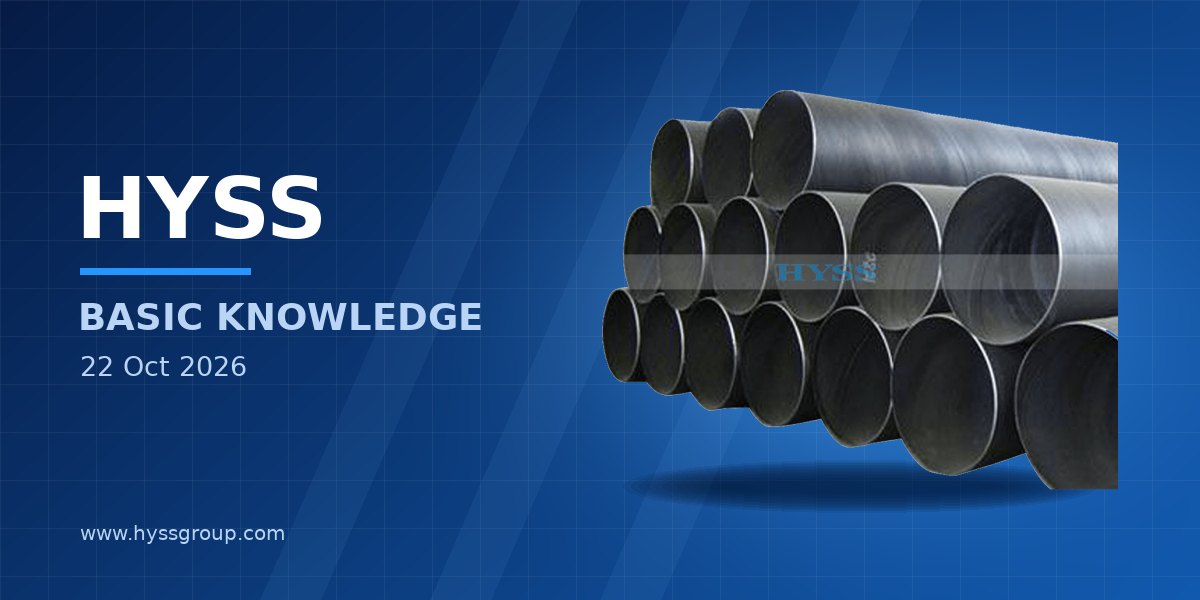
Buyers often see three ASTM specifications quoted for austenitic stainless tube and pipe: ASTM A312/A312M, ASTM A269/A269M and ASTM A213/A213M. They cover overlapping grades such as TP304L and TP316L, so they are easily confused. They are not interchangeable, because each was written for a different service and a different way of sizing and testing the product.
A312 is a pipe standard. Product is ordered by nominal pipe size (NPS) and schedule, such as NPS 6 Schedule 40S, and is intended to be joined into process piping with ASME B16.9 fittings and ASME B16.5 flanges. Dimensions normally follow ASME B36.19M for stainless pipe and ASME B36.10M where applicable.
Welded A312 pipe is made without filler metal in the standard route, and the specification covers a cold-worked welded variant. Check the supplementary requirements and the hydrostatic or nondestructive electric test clause, since the choice between them is defined in the specification and affects cost and documentation.
A269 is a tubing standard. Tube is ordered by actual outside diameter and wall thickness, not by NPS. It is the usual reference for instrumentation lines, hydraulic and sampling systems, and compression-fitting installations, where tolerance and surface condition matter more than pressure-pipe schedules.
It has less stringent coverage of heavy-wall, high-temperature pressure service than A213. For tight dimensional control, review the permitted variations and the flattening, flaring and hardness-type tests listed in the standard rather than assuming they match A312.
A213 is intended for boiler, superheater and heat-exchanger tubes. It is a seamless product, and it also includes ferritic alloy grades, which A312 and A269 do not. Tube is sized by outside diameter and either minimum or average wall, and the choice must be stated in the order. Heat-treatment condition, grain-size requirements for certain grades and mechanical testing frequency are specific to A213, so read these sections closely.
| Item | A312 | A269 | A213 |
|---|---|---|---|
| Product name | Pipe | Tubing | Boiler and heat-exchanger tube |
| Sizing | NPS and schedule | OD and wall | OD and minimum or average wall |
| Manufacture | Seamless or welded | Seamless or welded | Seamless only |
| Typical use | Process piping | Instrument and small-bore lines | Boilers, exchangers |
For code-governed work, the ASME Section II Part A counterparts are SA-312, SA-269 and SA-213. Allowable stresses come from ASME B31.3 or Section VIII, so the ASME designation matters for design. Comparable European standards include EN 10216-5 for seamless tubes for pressure purposes, EN 10217-7 for welded ones and EN ISO 1127 for dimensions. The Russian equivalents sit in the GOST system, and Australian practice often references AS 1528 for tube. Treat these as functional parallels, not exact substitutes, and confirm grade designations against a current comparison.
Related products: Steel pipes & tubes
THE MEMBERS OF HYSS GROUP
1.Zhejiang Hyss Corp.
2.Zhejiang Hyss pipeline Industry Corp.
3.Hyss International Trading (Shanghai) Co., Ltd.
4.Hyss International Limited.
5.Hyss International Logistics(Shanghai)Co.,Ltd.
6.Hebei Hyss Corp.
SALES CENTER OF HYSS GROUP
Add:Room 1507,No.1 Building,GuoSon Center,No.388
Zhongjiang Road,Shanghai,China
Postal Code:200062
Tel: 0086(21)62671680 / 62671061
Fax:0086(21)62671932
 The function is under construction, so stay tuned!
 la fonction est en construction, alors restez branchés!
 La función está en construcción, así que ¡mantente atento!
 A função está EM construção, então fiquem ligados!
 функция находится в стадии строительства, так что оставайтесь на связи!


