- 0086(21)62671680
- 62671061
- sales@hyssgroup.com
- Language
Pipe Schedules Explained: SCH 10S, 40, 80, 160, STD, XS and XXS (ASME B36.10M and B36.19M)
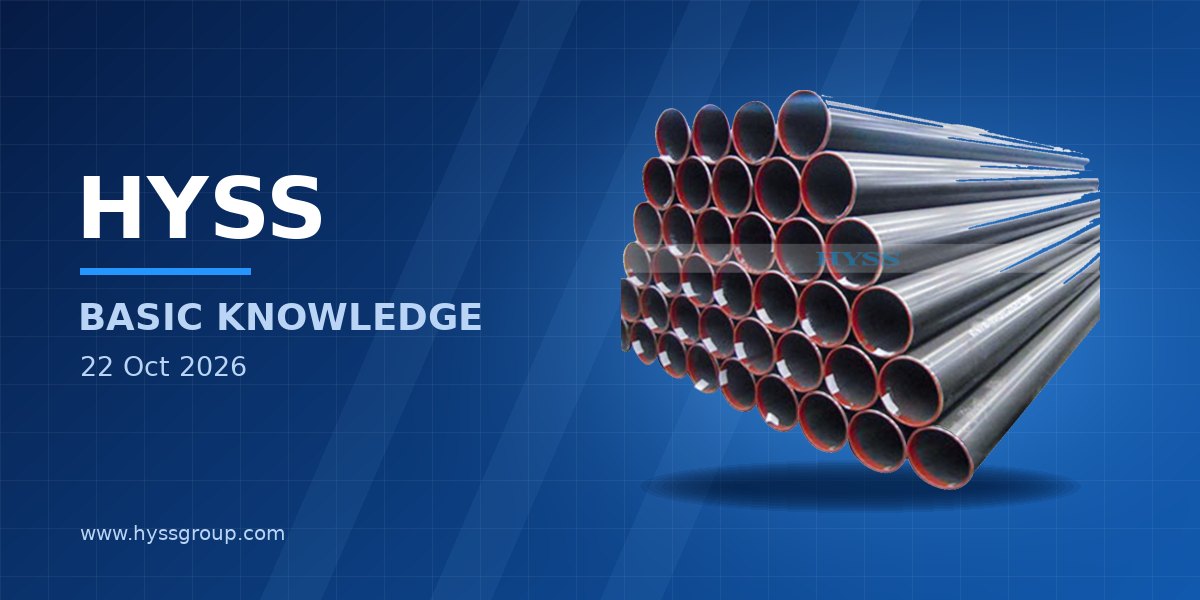
A pipe schedule is a designation for wall thickness within a given nominal pipe size (NPS). It is not a pressure rating and not a thickness in itself. The same schedule number gives a different wall for each NPS, so the designation must always be read together with the size.
The outside diameter of a given NPS stays fixed, so a heavier schedule reduces the inside diameter. This is why NPS and schedule together define the flow area, weight and pressure capacity of a pipe.
Two ASME standards cover dimensions for the schedules most buyers meet:
Do not assume that every schedule exists for every size. Each standard lists the available combinations in its dimension tables, and those tables are the only reliable source for wall thickness values.
| Designation | Origin | Practical note |
|---|---|---|
| SCH 10S | ASME B36.19M | Thin wall for stainless steel; often used for low-pressure service and where welding is easier on thinner sections |
| SCH 40 / 40S | B36.10M / B36.19M | Very common general-purpose wall; for many sizes it equals STD |
| SCH 80 / 80S | B36.10M / B36.19M | Heavier wall; for many sizes it equals XS |
| SCH 160 | B36.10M | High-pressure wall, mainly for carbon and alloy steel |
| STD | B36.10M | Standard weight |
| XS | B36.10M | Extra strong |
| XXS | B36.10M | Double extra strong; heavier than SCH 160 in many sizes |
STD, XS and XXS predate the schedule system. For smaller sizes, STD has the same wall as SCH 40 and XS the same as SCH 80. For larger sizes this equality no longer holds, and the weight-class wall can differ from the schedule wall. For this reason, state the designation exactly as the project specifies it and do not treat the terms as interchangeable without checking the table.
XXS has no matching schedule number in the standard; it is its own designation. Note also that SCH 160 and XXS are not the same wall, even if they are close in some sizes.
Allowable pressure depends on the wall thickness, outside diameter, material allowable stress at design temperature, manufacturing tolerance and corrosion allowance. Design codes such as ASME B31.3 (process piping) or ASME B31.1 (power piping) provide the calculation method; in Europe, EN 13480 applies to metallic industrial piping. Use the calculated minimum thickness to select the schedule, not the other way round.
ASME B36.10M wall thicknesses are nominal. Pipe made to ASTM product specifications, such as ASTM A106, ASTM A53/A53M, ASTM A312/A312M or ASTM A358/A358M, normally permits an under-tolerance on wall, and the permitted value is given in the product specification itself, not in B36.10M. Check that standard for the exact allowance and for how it relates to your minimum-wall requirement.
Outside North America, other systems exist. EN 10220 (dimensions and masses per unit length for welded and seamless pipes) and ISO 1127 for stainless steel pipe use outside diameter and wall thickness in millimetres instead of schedule numbers. GOST 8732 and GOST 8734 (seamless pipe) and DIN 2448 are further examples where wall is stated directly. AS/NZS 1163 and AS 1074 are used in Australia and New Zealand with their own size and wall designations. When converting between systems, match the real outside diameter and wall rather than the name.
Related products: Steel pipes & tubes
THE MEMBERS OF HYSS GROUP
1.Zhejiang Hyss Corp.
2.Zhejiang Hyss pipeline Industry Corp.
3.Hyss International Trading (Shanghai) Co., Ltd.
4.Hyss International Limited.
5.Hyss International Logistics(Shanghai)Co.,Ltd.
6.Hebei Hyss Corp.
SALES CENTER OF HYSS GROUP
Add:Room 1507,No.1 Building,GuoSon Center,No.388
Zhongjiang Road,Shanghai,China
Postal Code:200062
Tel: 0086(21)62671680 / 62671061
Fax:0086(21)62671932
 The function is under construction, so stay tuned!
 la fonction est en construction, alors restez branchés!
 La función está en construcción, así que ¡mantente atento!
 A função está EM construção, então fiquem ligados!
 функция находится в стадии строительства, так что оставайтесь на связи!


