- 0086(21)62671680
- 62671061
- sales@hyssgroup.com
- Language
ASME B16.5 Flange Pressure Classes 150 to 2500: Pressure-Temperature Ratings Explained
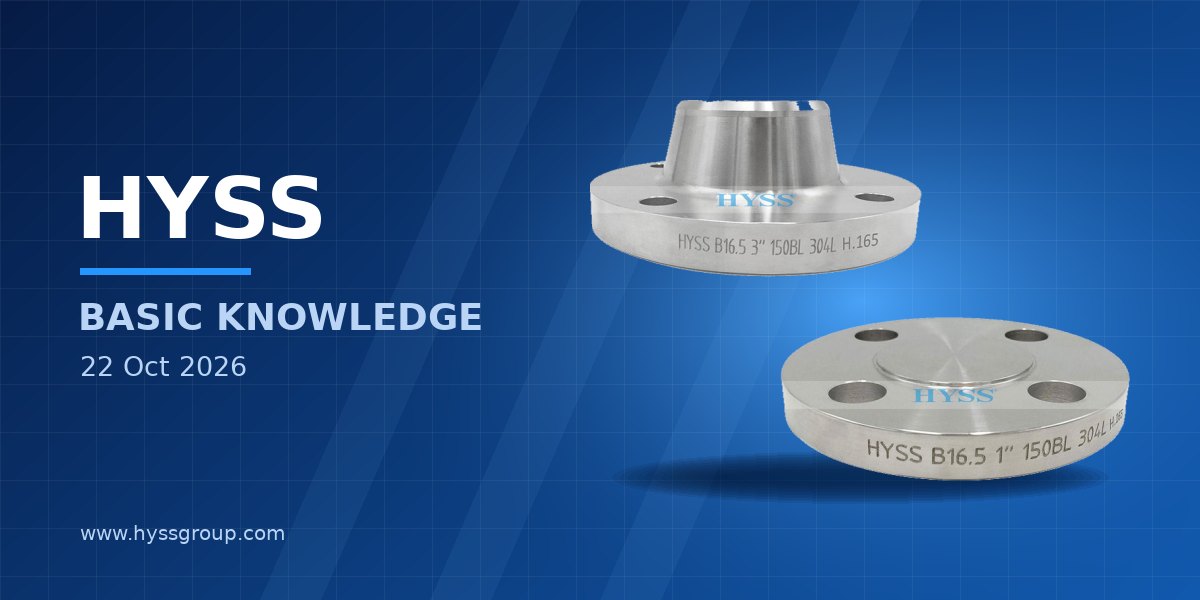
ASME B16.5, "Pipe Flanges and Flanged Fittings: NPS 1/2 through NPS 24 Metric/Inch Standard", defines flanges by pressure class, not by a fixed pressure in bar or psi. The seven classes are 150, 300, 400, 600, 900, 1500 and 2500. The class number is a dimensionless label. The pressure a flange may actually carry depends on two further factors: the material group and the operating temperature.
A Class 300 flange therefore does not mean 300 psi. It means a flange whose allowable pressure at a given temperature is read from the standard's rating tables.
Steel loses strength at elevated temperature, so the permitted working pressure decreases as temperature increases. Each material group in ASME B16.5 has its own pressure-temperature table. The tables list the maximum allowable gauge pressure at stepped temperatures, and they apply to the flange, the bolting and the gasket as a joint.
Two points are often missed:
ASME B16.5 sorts the materials it covers into groups (Table 1A of the standard lists the materials and assigns each a group number). Examples of the forged materials commonly assigned to groups are:
| Material specification | Typical product |
|---|---|
| ASTM A105 | Carbon steel forged flanges |
| ASTM A350 LF2 | Carbon steel for low-temperature service with impact testing |
| ASTM A182 F304/F304L, F316/F316L | Austenitic stainless steel flanges |
| ASTM A182 F11, F22 | Chromium-molybdenum alloy steel flanges |
Do not assume that two materials with similar names share a rating. A carbon steel flange and a stainless flange of the same class have different allowable pressures at the same temperature. Some stainless grades also have separate ratings depending on the carbon content or the heat-treatment condition. Always find the group number first, then the table.
The sequence is simple:
Class 150 is the lowest class. At higher temperatures its capacity falls markedly, so it is not interchangeable with a class chosen by pressure alone. Classes 900, 1500 and 2500 are used for severe duty, and for these classes the standard has specific rules on dimensions and on the use of larger sizes. Note that Class 2500 is covered only up to a limited size range in the standard; confirm the size limits in the edition you work to.
EN 1092-1 uses PN designations and its own material groups, with ratings given in EN 1092-1 tables. DIN flanges (the national predecessors of the EN series) and GOST 33259 flanges follow a PN logic too. AS 4087 applies in Australia. PN and class are not directly equivalent: class 150 and PN 20 or PN 16 flanges may share some bolt-hole patterns at certain sizes, but they should not be treated as interchangeable without checking dimensions and ratings in each standard.
Related products: Forged flanges
THE MEMBERS OF HYSS GROUP
1.Zhejiang Hyss Corp.
2.Zhejiang Hyss pipeline Industry Corp.
3.Hyss International Trading (Shanghai) Co., Ltd.
4.Hyss International Limited.
5.Hyss International Logistics(Shanghai)Co.,Ltd.
6.Hebei Hyss Corp.
SALES CENTER OF HYSS GROUP
Add:Room 1507,No.1 Building,GuoSon Center,No.388
Zhongjiang Road,Shanghai,China
Postal Code:200062
Tel: 0086(21)62671680 / 62671061
Fax:0086(21)62671932
 The function is under construction, so stay tuned!
 la fonction est en construction, alors restez branchés!
 La función está en construcción, así que ¡mantente atento!
 A função está EM construção, então fiquem ligados!
 функция находится в стадии строительства, так что оставайтесь на связи!


