- 0086(21)62671680
- 62671061
- sales@hyssgroup.com
- Language
ASTM A106 vs ASTM A53 vs API 5L: How to Choose Carbon Steel Pipe
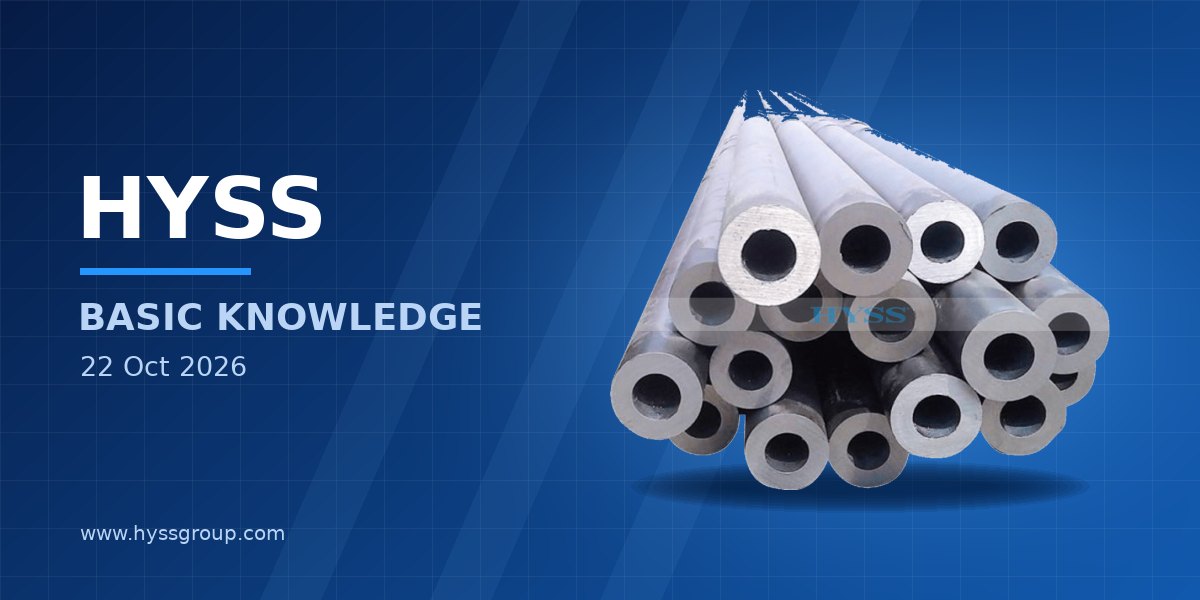
ASTM A106, ASTM A53/A53M and API 5L are the carbon steel pipe specifications that appear most often in enquiries from overseas buyers. They overlap in size range and appearance, but they were written for different duties. Choosing the wrong one can cause rejected documentation, extra testing or a pipe that does not suit the design code.
ASTM A106/A106M covers seamless carbon steel pipe for high-temperature service. It is a piping-material standard, widely referenced by ASME B31.1 (power piping) and ASME B31.3 (process piping). Grades are A, B and C.
ASTM A53/A53M covers black and hot-dip zinc-coated pipe, welded or seamless, for mechanical and pressure applications and for ordinary uses in steam, water, gas and air lines. Types include F (furnace-butt-welded), E (electric-resistance-welded) and S (seamless), with grades A and B depending on type.
API 5L, also published as ISO 3183, covers line pipe for pipelines transporting oil, gas and water. It defines product specification levels PSL 1 and PSL 2, and grades are named by strength level, such as B or X-grades. Seamless and several welded processes are included.
| Aspect | ASTM A106 | ASTM A53 | API 5L |
|---|---|---|---|
| Manufacturing | Seamless only | Seamless, ERW or furnace-welded | Seamless and welded (ERW, SAW, others) |
| Typical duty | High-temperature piping | General and low-pressure service | Pipelines |
| Coating option | Not a feature of the standard | Black or galvanized | Coatings applied by separate agreement |
| Quality tiers | One level | One level | PSL 1 and PSL 2 |
Service temperature. For elevated temperatures, A106 is usually the specified product, because its seamless construction and chemistry controls (including silicon requirements) are aimed at that duty. Always check what the design code permits for the material at your operating temperature.
Seamless or welded. If the piping specification demands seamless pipe, A53 Type S or A106 qualifies, but A53 Type E does not. Confirm the process in the purchase order, not only the grade.
Galvanizing. If zinc coating is needed for water or structural-type lines, A53 is the natural route. Galvanizing A106 is possible as a separate operation, but should be agreed explicitly.
Pipeline versus plant piping. Cross-country and transmission lines are normally specified to API 5L, often with PSL 2 where tighter control and mandatory toughness requirements apply. Within a plant, A106 or A53 is more common. Check the applicable pipeline code, such as ASME B31.4 or B31.8.
Dual certification. Pipe is sometimes certified to more than one standard, for example A53 Grade B with API 5L Grade B. This is only valid when the product meets every requirement of each standard, so request test certificates that show both and verify against the current editions.
There is no exact one-to-one equivalent, and substitutions should be approved by the designer. Common reference points are:
Outside diameter and wall thickness for all three are normally referenced to ASME B36.10M by NPS and schedule. Hydrostatic testing, non-destructive electric testing and any impact testing differ between standards and between product levels. Read the testing and supplementary requirement sections of the specific edition, and state any options in the order, since some tests apply only when the purchaser specifies them.
Related products: Steel pipes & tubes
THE MEMBERS OF HYSS GROUP
1.Zhejiang Hyss Corp.
2.Zhejiang Hyss pipeline Industry Corp.
3.Hyss International Trading (Shanghai) Co., Ltd.
4.Hyss International Limited.
5.Hyss International Logistics(Shanghai)Co.,Ltd.
6.Hebei Hyss Corp.
SALES CENTER OF HYSS GROUP
Add:Room 1507,No.1 Building,GuoSon Center,No.388
Zhongjiang Road,Shanghai,China
Postal Code:200062
Tel: 0086(21)62671680 / 62671061
Fax:0086(21)62671932
 The function is under construction, so stay tuned!
 la fonction est en construction, alors restez branchés!
 La función está en construcción, así que ¡mantente atento!
 A função está EM construção, então fiquem ligados!
 функция находится в стадии строительства, так что оставайтесь на связи!


